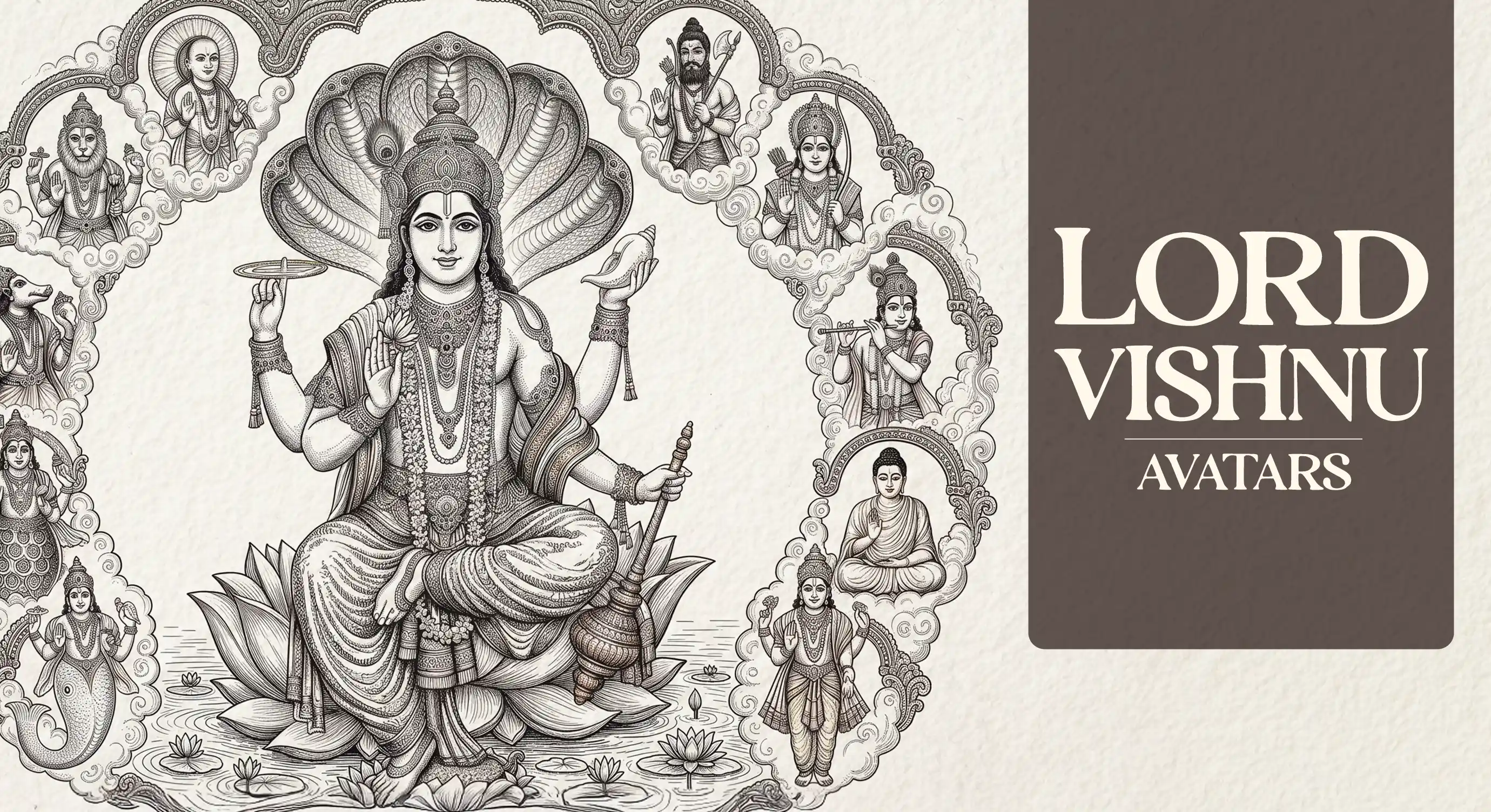
Lord Vishnu is the source and maintainer of the whole universe. He is commonly depicted with four arms holding a conch (Shankha), discus (Sudarshana Chakra), mace (Gada), and lotus (Padma), symbolizing His divine power, protection, and wisdom. Lord Vishnu descends on the universe in the divine forms (Avatars) such as Lord Rama, Lord Narsimha, and Lord Varaha. Devotees worship Him with great reverence, seeking His blessings for protection, peace, prosperity, and spiritual well-being.
What Is Dashavatara? (Meaning and Significance)
The Dashavatara refers to the ten principal divine incarnations (Avatars) of Lord Vishnu. Each Avatar is non-different from the Lord Himself. The ten principal incarnations of Lord Vishnu hold deep religious, cultural, and spiritual significance in Hinduism. The stories of these avatars inspire devotees to develop qualities such as truthfulness, courage, compassion, humility, patience, and selfless service.
Why Did Lord Vishnu Take Different Avatars?
Lord Vishnu takes different Avatars on the planet to protect His devotees and to kill the demons. The Lord never becomes angry for His own sake. However, when someone harms or offends His devotees, He does not tolerate such offenses and protects those who have surrendered to Him. Lord’s every Avatar is beyond the modes of material nature; whether it is Varaha or Matsya are always worshipable.
10 Avatars of Vishnu in Order (Quick List)
1. Matsya Avatar (Fish)
2. Kurma Avatar (Tortoise)
3. Varaha Avatar (Boar)
4. Narasimha Avatar (Man-Lion)
5. Vamana Avatar (Dwarf Brahmin)
6. Parashurama Avatar (Warrior Sage)
7. Rama Avatar (Ideal King)
8. Krishna Avatar (Spiritual Master of everyone)
9. Buddha Avatar (Propagator of Shunyavada/Voidism)
10. Kalki Avatar (Future Savior)
10 Avatars of Lord Vishnu: Names, Stories, and Significance
1. Matsya Avatar
According to Hindu scriptures, King Manu was performing penance when he found a tiny fish seeking protection. As he cared for it, the fish grew rapidly and revealed Himself as Lord Vishnu. The Lord warned Manu about a great flood that would destroy the world and instructed him to build a large boat carrying sages, seeds, and living creatures. When the great flood arrived, Matsya Avatar pulled the boat safely through the waters using a divine serpent as a rope. Lord Matsya also defeated the demon Hayagriva, who had stolen the Vedas, and restored the sacred scriptures to Lord Brahma.
Significance
Matsya Avatar symbolizes divine protection, preservation of knowledge, and hope during difficult times. The story teaches that faith, righteousness, and wisdom help humanity overcome adversity. It also reminds us that God safeguards creation and restores order whenever chaos threatens the world.
2. Kurma Avatar
When the devas and asuras sought the nectar of immortality (Amrita), they decided to churn the cosmic ocean. They used Mount Mandara as the churning rod and the serpent Vasuki as the rope. However, the mountain began to sink into the ocean because it had no support. Lord Vishnu then incarnated as Kurma, a gigantic tortoise, and held the mountain steady on His back. With His support, the churning continued successfully, yielding many divine treasures, including Goddess Lakshmi and the pot of Amrita.
Significance
Kurma Avatar represents patience, stability, and selfless support. Just as the tortoise carried the mountain without seeking recognition, this incarnation teaches that lasting success depends on perseverance, cooperation, and a strong foundation.
3. Varaha Avatar
The demon Hiranyaksha dragged the Earth (Bhudevi) into the cosmic ocean, causing disorder throughout the universe. To rescue the Earth, Lord Vishnu appeared as Varaha, a mighty boar with immense strength. A fierce battle followed between Varaha and Hiranyaksha, lasting many days. Finally, Lord Varaha defeated the demon and lifted the Earth on His powerful tusks, restoring it to its rightful place in the universe. The gods praised the Lord for saving creation and re-establishing balance and harmony.
Significance
Varaha Avatar symbolizes courage, protection, and the triumph of righteousness. It teaches that no challenge is too great when justice is at stake and reminds us that the Divine protects the world whenever evil threatens peace and harmony.
4. Narasimha Avatar
The demon king Hiranyakashipu received a boon that made him nearly impossible to kill. Believing himself invincible, he forbade everyone from worshipping Lord Vishnu. However, his young son Prahlada remained a devoted follower of the Lord. Enraged, Hiranyakashipu repeatedly tried to kill him but failed. One day, he challenged Prahlada by asking whether Vishnu existed inside a palace pillar. Lord Vishnu immediately appeared from the pillar as Narasimha, a half-man, half-lion form. At twilight, He placed Hiranyakashipu on His lap and killed him with His claws, fulfilling every condition of the boon.
Significance
Narasimha Avatar teaches that sincere devotion is always protected. It reminds us that arrogance and injustice ultimately fail, while faith, truth, and righteousness always receive divine protection.
5. Vamana Avatar
King Bali was a generous and powerful ruler who gained control over the three worlds through his strength and devotion. To restore cosmic balance, Lord Vishnu appeared as Vamana, a young Brahmin dwarf, and requested only three paces of land. Bali gladly agreed. Vamana then assumed a gigantic cosmic form. With one step, He covered the Earth; with the second, He measured the heavens, leaving no space for the third. Bali humbly offered his own head, and Lord Vishnu blessed him for his humility and devotion while restoring the authority of the devas.
Significance
Vamana Avatar teaches that humility is greater than pride and that true greatness lies in surrendering to righteousness. The story also shows that God values devotion and integrity more than worldly power.
6. Parashurama Avatar
Parashurama was born to Sage Jamadagni and Renuka and was known for his mastery of warfare and deep spiritual wisdom. During his time, many Kshatriya rulers became corrupt and abused their power, causing suffering to innocent people. To restore justice, Lord Vishnu incarnated as Parashurama, wielding a divine axe gifted by Lord Shiva. He defeated the oppressive rulers and upheld dharma. Despite being a fearless warrior, Parashurama lived the life of a sage, dedicating himself to penance, knowledge, and righteousness after fulfilling his divine mission.
Significance
Parashurama Avatar represents justice, discipline, and the responsible use of power. His life teaches that strength should always be guided by wisdom and used only to protect righteousness and the welfare of society.
7. Rama Avatar
Lord Rama, the prince of Ayodhya, is the central figure of the Ramayana and is revered as the ideal king. After being exiled to the forest for fourteen years, He lived a life of simplicity with His wife Sita and brother Lakshmana. During their exile, the demon king Ravana abducted Sita, leading Rama to ally with Hanuman and the Vanara army. After a fierce battle in Lanka, Rama defeated Ravana and rescued Sita. He later returned to Ayodhya, where His coronation marked the beginning of a peaceful and prosperous reign known as Rama Rajya.
Significance
Rama Avatar represents truth, duty, integrity, and ideal leadership. His life teaches the importance of keeping one's promises, respecting relationships, and fulfilling responsibilities with honesty and compassion. Lord Rama continues to inspire people to lead a righteous and virtuous life.
8. Krishna Avatar
Lord Krishna was born in Mathura to Devaki and Vasudeva at a time when the tyrant King Kamsa ruled with cruelty. To protect Him, Krishna was secretly taken to Gokul, where He spent His childhood performing miraculous deeds and defeating many demons. As He grew older, He killed Kamsa and restored peace to the kingdom. In the Mahabharata, Krishna became Arjuna's guide and charioteer. On the battlefield of Kurukshetra, He delivered the timeless teachings of the Bhagavad Gita, explaining duty, selfless action, devotion, and the path to spiritual realization.
Significance
Krishna Avatar teaches that true success comes from performing one's duties with wisdom, devotion, and selflessness. His life inspires people to face challenges with courage, uphold righteousness, and cultivate compassion, love, and spiritual understanding in everyday life.
9. Buddha Avatar
According to Hindu tradition, Lord Buddha is regarded as the ninth avatar of Lord Vishnu. Born as Prince Siddhartha, He renounced His royal life after witnessing human suffering in the form of old age, sickness, and death. Through deep meditation and spiritual practice, He attained enlightenment and became known as the Buddha, meaning the Enlightened One. He spent the rest of His life teaching compassion, non-violence, mindfulness, and the path to overcoming suffering. His teachings encouraged people to live with kindness, wisdom, and respect for all living beings.
Significance
Buddha Avatar emphasizes compassion, peace, and non-violence. His teachings inspire people to overcome anger, greed, and ignorance through self-discipline and wisdom, promoting harmony within oneself and in society.
10. Kalki Avatar
According to Hindu scriptures, Kalki is the future and final avatar of Lord Vishnu, who is yet to appear. He is expected to descend at the end of Kali Yuga, when righteousness has almost disappeared, and injustice dominates the world. Scriptures describe Kalki as a mighty warrior riding a white horse and wielding a blazing sword. He will destroy evil forces, punish the wicked, and restore dharma. After fulfilling His divine mission, Kalki will usher in a new Satya Yuga, marking the beginning of a new cycle of truth, peace, and righteousness.
Significance
Kalki Avatar symbolizes hope, justice, and renewal. His future appearance reminds humanity that evil is temporary and righteousness will ultimately prevail. The story encourages people to uphold moral values and remain steadfast in virtue, even during challenging times.
Lessons from the Dashavatara
From the Dashavatara, we can take the lesson that dharma always wins against adharma because Lord Vishnu personally takes its side and protects His devotees. The stories of the ten avatars also teach many important values for life. Vamana Avatar teaches humility and reminds us that power should never lead to arrogance. Lord Rama's life teaches truthfulness, duty, and ideal conduct, while Lord Krishna's teachings guide us to perform our responsibilities with wisdom and devotion.
Conclusion
Lord Vishnu is the controller of everything, and there is no one superior to Him. He incarnates in different Avatars for His devotees and to establish dharma. Every Avatar has full potency because it is the Lord Himself and is worshipped all over the three worlds. Hearing or reading about the ten Avatars of the Lord bestows pious credits, which help one to advance in spiritual life.